Mall #1: Aberdeen, by Chris Cheung
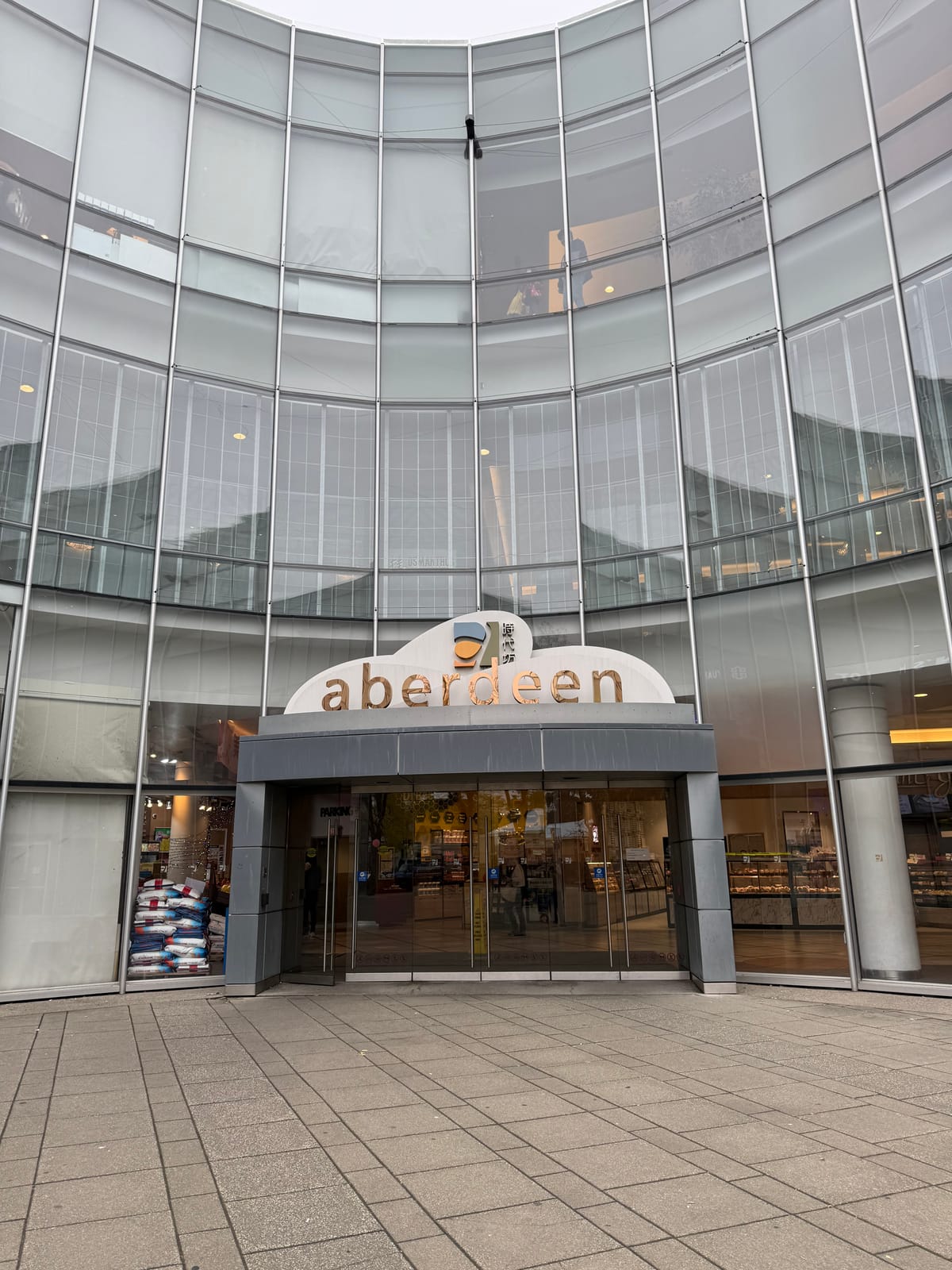
Aberdeen Mall
Location: Richmond
Opened: 1989
Approximate number of stores: 150
Anchor tenants: H-Mart, Oomomo
Aberdeen Centre is always full of surprises.
You might be handed a red envelope by Pierre Poilievre, sporting a tang suit in Conservative blue, here on the eve of the Lunar New Year to rub shoulders with Richmondites who love his tough-on-crime message.[1]
You might catch a glimpse of Lokman Yeung and Anson Kong, members of Hong Kong’s hottest boyband of the moment Mirror, mobbed by their fans on this side of the Pacific.
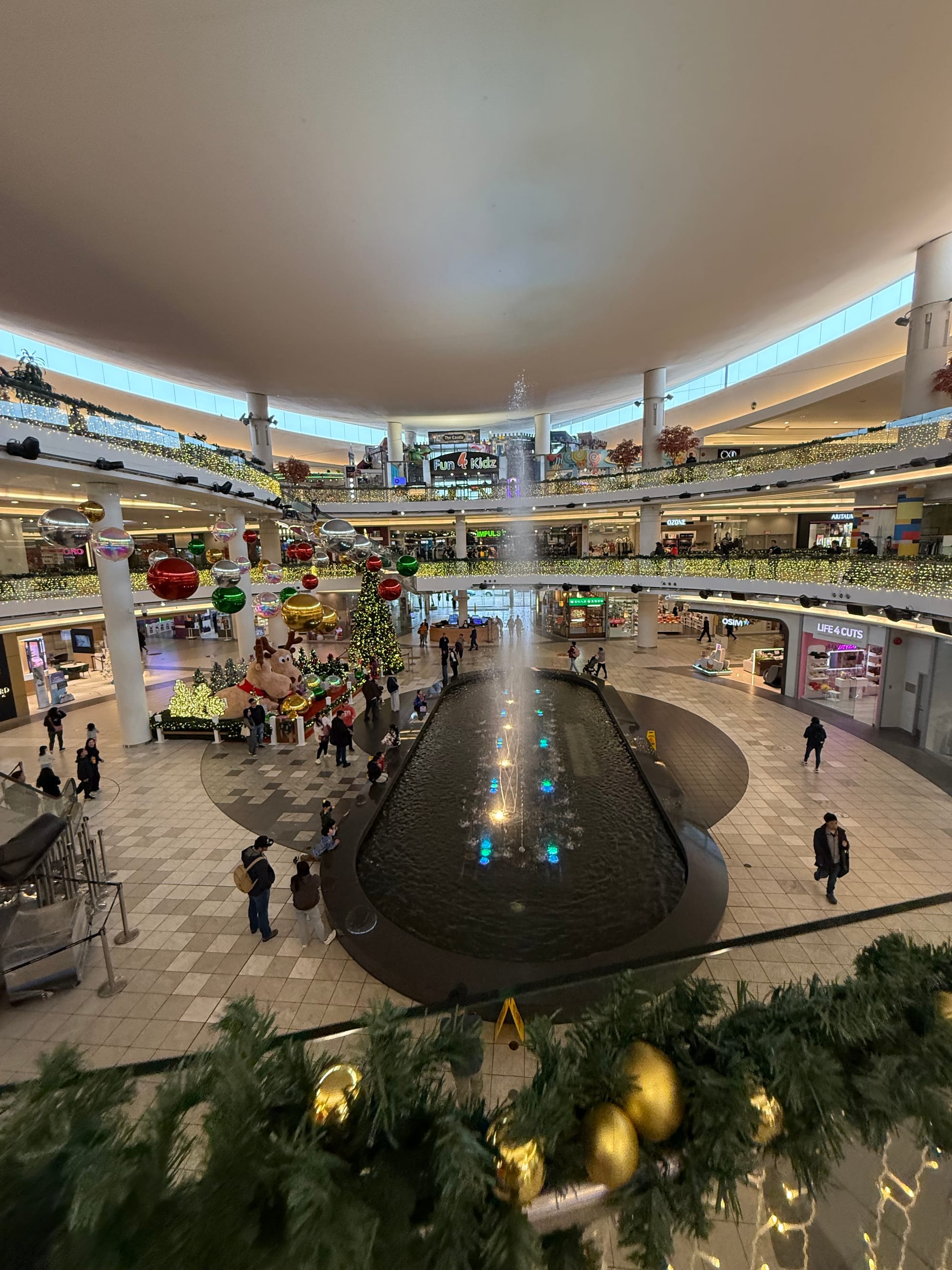
You might be dwarfed by a recreation of Big Ben made of Lego, an inflatable double-decker of Little Miss characters, a forest of fake sakuras frozen in eternal spring, ever-ready for photo-ops.
There is no mall like Aberdeen in Metro Vancouver. It’s both a portal to East Asia and a centre of Chinese Canadian life; both for local tourists and tourists who have become locals.
Sure, everyone still calls it an “Asian mall,” but it’s become a mall for everyone. When the Canada Line came through in 2009, they couldn’t help but build and name a station after Aberdeen. Richmond — often called North America’s “most Asian city”[2] — was linked up to the rest of the region, and began to shed its reputation as a remote enclave.
I was 11 years old when the mall first opened in 2003. I hadn’t been to East Asia, but it seemed like East Asia was going to come to us. There was incredible fanfare, so much that my parents waited until the commotion died down before bringing us for a visit.
Aberdeen has its must-sees as well as its mysteries. Oomomo, formerly branded as Daiso Canada, is a must-see: the toonie-plus store across two large floors was there at the beginning and remains a go-to for Japanese home goods. De Rucci is among the mysteries, the China-based mattress store branded as the brainchild of a made-up French-Italian genius named Leonardo De Rucci, whose giant portrait stares down shoppers like an angrier Steve Jobs.[3]
This is part of the fun of Aberdeen, seeing fads from overseas that don’t quite translate on these shores, but you can’t help but be impressed by the grand fashion in which the mall tries to sell them.
The food court on the third-floor has so many delicious offerings, from xiaolongbao to shaved ice, in a heavily trafficked area where business is cutthroat (RIP Triple-O’s).
One of the survivors from the mall’s inception is the formidable Wu Fung. The stall serves the fare of Hong Kong streetcarts, and you’ll see that just about every table has ordered their personal favourite, poking at braised tripe and curry fish balls with bamboo picks, lost in the memory of eating such dishes standing on a Kowloon street corner.
But the popular favourite is the chicken. The Cantonese descriptor for the whole wings approximately translates to “wind-swept sands,” formidable z-shaped zigzags, dusted with five-spice, hot as hell as they come out of the fryer.
Aberdeen remains the crown jewel of Richmond’s approximately dozen Asian malls, most of which were built during a frenzy in the 1990s by a collection of Hong Kong, Taiwanese, and Japanese developers. Big buildings are big investments, and behind them were big personalities.
The titan who built Aberdeen Centre was the one and only Thomas Fung.
His father Fung King-hey, a legendary stocktrader who made his fortune as the Hong Kong economy roared, brought the family to Vancouver in 1967. Teenage Thomas graduated from Magee high school on the west side, before dabbling in everything from film production to pastry arts, would build his Fairchild empire that touches the lives of every single Chinese Canadian.
Where did the name come from?
Fung once told the Hong Kong Economic Times: “When I was small, no matter how hard working I was and how well I did, father would only commented a ‘fair’, or ‘OK.’ His purpose was to encourage us to do better, that there are always space for improvement.”[4]
His radio and TV channels, which have studios in Aberdeen, beam Chinese-language news and programming into immigrant households. His Saint Germain chain of bakeries feeds buns to school children and prepares seasonal treats like mooncakes for mid-autumn. His malls, of which Aberdeen Centre is only one in B.C. and Ontario, are the containers of diasporic life.
Shops sell cultural goods that range from electronic rice cookers to the latest cinema on DVD; offices are home to trilingual banks, doctors, notaries and more; programming offers a place to countdown the Lunar New Year and grab some dragon’s beard candy.
While the first iteration of Asian malls were indoor Chinatowns without the urban grit detested by educated immigrants — the typical specimen home to at least one greengrocer, one fishmonger, one seller of dried goods, one TCM practitioner, one seafood restaurant for dim sum and banquets — Fung took Aberdeen Centre 2.0 another step further.
The original Aberdeen was demolished in 2002 and rebuilt by 2004, the lab for Fung’s commercial experimentations. There were brands like Giordano from Hong Kong, Beard Papa’s from Japan, Triple-O’s from our own city and an H-Mart supermarket from the U.S. by way of Korea. Fung even scoured the continent’s food courts looking for the perfect chair, locating the design in the basement of a Toronto food court which they photographed and recreated for the modern day, with light wood and a curved back.[5]
Fung is constantly pushing the boundaries of what an “Asian mall” can be. A piano school might be obvious, but how about a flight centre? Get your pilot license at Sea Land Air on the second floor. And why not add a 24/7 Anytime Fitness? “I’m not in the gym business,” he once told Business in Vancouver. “But it seems they are doing well. When I talk to other mall operators, they’d like to bring gyms in.”[6]
And in a city where there was racist backlash from residents against “un-Canadian” Chinese signs[7], Fung was ahead of the curve, requiring that tenants feature English on at least two-thirds of their signs and that all of the mall’s performances be bilingual.
Fung and Fairchild might’ve carefully controlled the mix, but credit is also due to their choice of an architect: Bing Thom.
Thom was part of a cohort who studied under the master Arthur Erickson before making a name for himself. The circles, curves, and clerestories of Aberdeen echo his other signature works in the region, from UBC’s Chan Centre to his transformative Central City for Surrey.
Light pours into Aberdeen, a counter to Richmond’s window-sparse Asian malls. Open atriums offer a sense of welcome and community. My friend Ian Young, who was the Vancouver correspondent for the South China Morning Post before heading up the B.C. bureau at Canadian Press, called it Richmond’s de-facto “city square.”
Indeed, as pro-democracy protesters took to the streets of Hong Kong, hundreds of Vancouverites showed up at Aberdeen in solidarity, filling the main atrium and singing the protest anthem “Glory to Hong Kong”[8] — another surprising use of space, but one that management could never have predicted.
The main atrium might be lined with salons and boutiques, with a fountain that might splash to a tune from The Sound of Music, overlooked by the food court stalls on the third floor showing off tonkatsu and cream puffs. But in a suburban landscape, even a container of consumerism has to make room for community.
Oh, did I forget about Aberdeen Square? Most people do. It might be the wing of Aberdeen that’s connected to the Canada Line station, but it’s connected to Aberdeen Centre by the saddest corridor in the world, with exposed wiring and HVAC.
That being said, take the time to wander its warrens, its corridors of cubicles that are like the neighbourhood malls of Hong Kongs, often attached to apartment blocks. There are sad messes left behind by vacant tenants, but the occupants have brought an interesting life to this appendix of Aberdeen. The eclectic collection of barbers, tea shops, rug tufters, risograph printers, and Magic tournaments are proof that Aberdeen is ever evolving.
A taste of Asia is only a train ride away.
Chris Cheung is a Vancouver journalist and writer and author of the upcoming book Very Vancouver: Uncovering the Soul of a West Coast City.
TOTAL SCORE
Small Stores: 7.5/10 (There’s tons to take in, from candies to cards to toilets to pianos, even if few of them feel absolutely essential)
Anchor Tenants: 4.8/10 (Oomomo and H-Mart are solid, but that’s pretty much it for large spaces outside of restaurants, which doesn’t leave a lot of variety)
Food Court: 8.3/10 (Solid A grade, every Asian option under the sun, always busy, even if sometimes you can feel the quality slip because the outlets are built to serve tons of people relatively cheaply)
Design/Accessibility 7.9/10 (The atrium is top tier, and the overall design of the main centre is visually pleasing and simple to understand, but integration with the Canada Line leaves lot to be desired)
X-Factor: 8/10 (A really lovely a distinct place that’s interesting to consider, even if you can start to feel some of the age)
OVERALL: 36.3/50. A mall that knows what it is, with clear strengths (food court and atrium) and weaknesses (minimal anchors and a confusing expansion), which embodies the community well and is worth enjoying on a visceral and cultural level.
https://www.travelandleisure.com/spending-lunar-new-year-in-british-columbia-canada-chinatown-8781464 ↩︎
https://www.fairchildgroup.com/pdf/2010_0703_HK-EconomicTimes_eng.pdf ↩︎
https://vanmag.com/city/people/thomas-fungs-wonder-years/ ↩︎
https://www.richmond-news.com/local-business/bc-mall-owners-seek-attractions-over-anchor-tenants-3082302 ↩︎
https://nationalpost.com/news/politics/richmond-b-c-considers-banning-chinese-only-signs-amid-uproar-over-citys-un-canadian-advertisements ↩︎
https://www.richmond-news.com/local-news/video-hundreds-sing-for-hong-kong-in-aberdeen-centre-3107113 ↩︎