
Mall Profile #9: Coquitlam Centre, by John Roddick
Coquitlam Centre is a 1980s style suburban mall that has tried to stay relevant with renovations and buzzier retail options — but does it fully work?
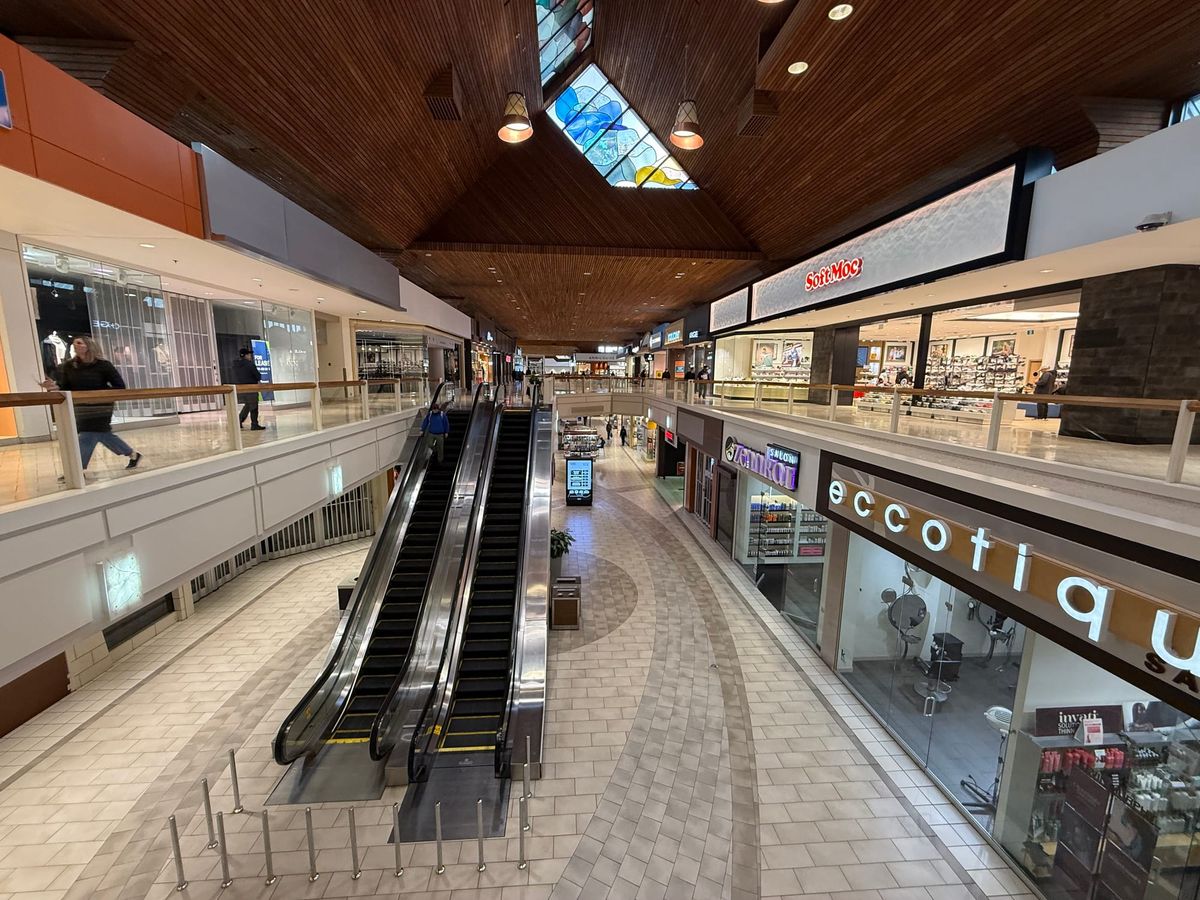
Coquitlam Centre
Location: Coquitlam
Opened: 1979
Approximate number of stores: 200
Anchor tenants: Walmart, London Drugs, Best Buy, Ardene

I feel it’s important to begin by admitting that I’ve only set foot in Coquitlam Centre four or five times in my life. It’s not particularly close to my apartment or office, nor is it home to my dentist or accountant, and I don’t believe I’ve ever bought anything there I haven’t eaten on site.
But by any reasonable interpretation, Coquitlam Centre is the ghost of my beloved childhood mall: Edmonton’s Heritage Mall, designed around the same time, in the same style, by the same architect.
The year was 1981, and fresh off the successful realization of Coquitlam Centre two years earlier (although still a year away from being awarded a Governor General’s Medal in architecture for that project) architect B. James Wensley returned to his Albertan hometown to design a new mall in the city’s south end. The newer shopping centre borrowed many design elements from its West Coast cousin, from its characteristic hemlock ceilings lit by dramatic skylights to its cruciform circulation scheme, each arm terminating at a huge department store anchor tenancy. A young architect-to-be haunted the Wizard’s Castle arcade, the San Francisco novelty gift store, and the pizza place in the food court that served slices as big as a phone book, all arrayed around a central court with palm trees and a four storey waterfall.
This was my childhood and teenage era mall, experienced during the 80’s and 90’s, arguably the height of influence on popular culture for malls writ large, and ultimately Heritage Mall was fated to speed run the familiar arc of the suburban mall, closing after less than 20 years of operation after its Eatons and Sears and Walmart all departed.
Coquitlam Centre was able to make the somewhat awkward transitions and renovations necessary to survive in the 21st century. Visiting it as an adult engenders a curious kind of nostalgia grafting that offers a unique lens through, which to consider a contemporary shopping centre in 2026. I don’t know if it’s possible to overstate the buzzy sensation of feeling like you’ve stepped back into a critically important space you hadn’t entered in 25 years.
The mall’s most prominent and storied feature happens when you tilt your head up: its lofty hemlock ceiling generously endowed with skylights and stained glass art, immediately and powerfully evoking the prairie mall it inspired. Separately, the ceiling’s wood finish and glazed elements are unique and impressive, but it’s the combination of the two features that creates the incredibly beautiful atmosphere that contributed to the mall’s initial impact and remains its greatest strength. Thoughtfully angled ceiling planes obliquely catch the natural light, while the thin wood members with their rich organic colour produce striking texture and depth. With decades of renovation work occurring largely within twenty feet of the floor plane, to simply tilt one’s head upward is to enjoy a view of the mall largely untouched by time.

?file=Heritage_Mall_Edmonton.jpg&ref=foodcourtinsession.ca)
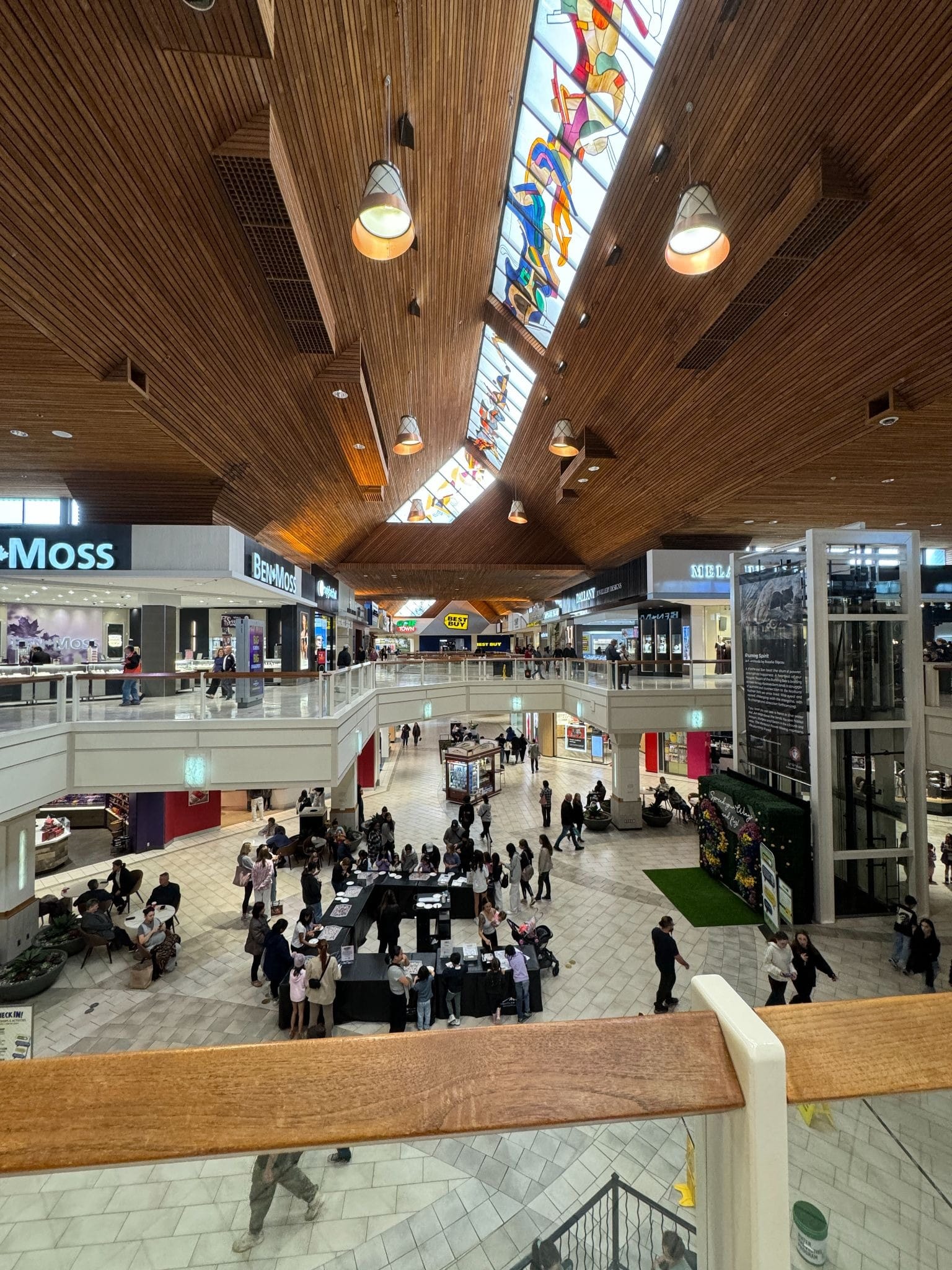
Spatially, too, Coquitlam Centre once influenced and now recalls my Heritage Mall. As a kid, I would set my bearings by the prominently visible retail anchors at the end of each arm of the building. Certainly the foundation of a similar scheme persists at Coquitlam Centre. However, it is here that the cracks start to appear in the nostalgic facade.
The earliest malls had simple circulation schemes predicated on the gravity of larger commercial entities: two of the founding anchor tenants, Eaton’s and The Bay, were the two largest Canadian retailers of the 1980s, and as such reasonably considered as solid a foundation for a major shopping centre as concrete and rebar. Put them at either end of the mall, have a visually pleasing roof, and 80% of the job is done. But while navigating Coquitlam Centre I continuously felt a disorientation characteristic of a building scheme predicated on effortlessly herding consumers through a planned retail landscape that no longer exists.
An essential component of what makes traditional malls work — anchor tenants with the juice to draw people through the fabric of smaller shops — is missing. Today, valiantly trying to fill the role are lesser tenancies without the chops to drive traffic or the size to act as signposts for entire wings of the building. Where once the proud yet austere Eaton’s font stretched across major corridors on two levels, we now get a diluted Ardene store above a thoroughly mid Accents@Home. The old anchor tenant of The Bay at the terminus of a retail corridor has been shuttered since 2020, a large blank wall severing the carefully designed circulation route, throwing the whole scheme out of whack. Throughout the building, some buzzier outlets fill some of the smaller spaces in between, like Uniqlo and an Apple Store, but I would argue their location no longer prioritizes the clarity and cohesion of the original mall design.
Also of note, and more attributable to intentional design decisions, is how the 2001 addition imperfectly integrates with Coquitlam Centre’s original aesthetic and layout. Efforts were clearly made to match the lofty peaked form of the existing characteristic roof in the new wing, but all the exposed open-web steel trusses, painted white, can’t help but introduce a jarring point of disconnect between old and new, a clear feeling of a grafted on extension. Less obvious but in my mind more insidious is the building addition, a single storey which introduces a disorienting layout variation across the two retail floors, situated as the primary link to Lincoln Station. Add in the sloping site, and the resultant at-grade major entry point is actually on the upper level, which makes it difficult to shake the feeling that the “ground floor” is actually subterranean, likely part of the reason what that floor and the atrium lack any real energy.
And so, just as the uncanny valley first draws us in with familiarity, creating a sort of false intimacy that ultimately amplifies flaws, I walk away from Coquitlam Centre with some of the nostalgic glow from my Heritage Mall scuffed off, feet more firmly on the ground. If it had survived past the turn of the millenium like Coquitlam Centre, it would probably be diminished as well, its inevitable changes over time an even more personal betrayal. But regardless of some incongruency with my memories, something about the bones of an 80’s mall will always keep me coming back. Whenever I’m craving a hit of semi-adulterated nostalgia, I look forward to riding the Skytrain (sparing a contemptuous glance at The Amazing Brentwood as I pass) to visit a suburban 1980s shopping mall that manages to still work, if imperfectly, in 2026.
You can’t go home again, but sometimes you can tilt your head up and squint.
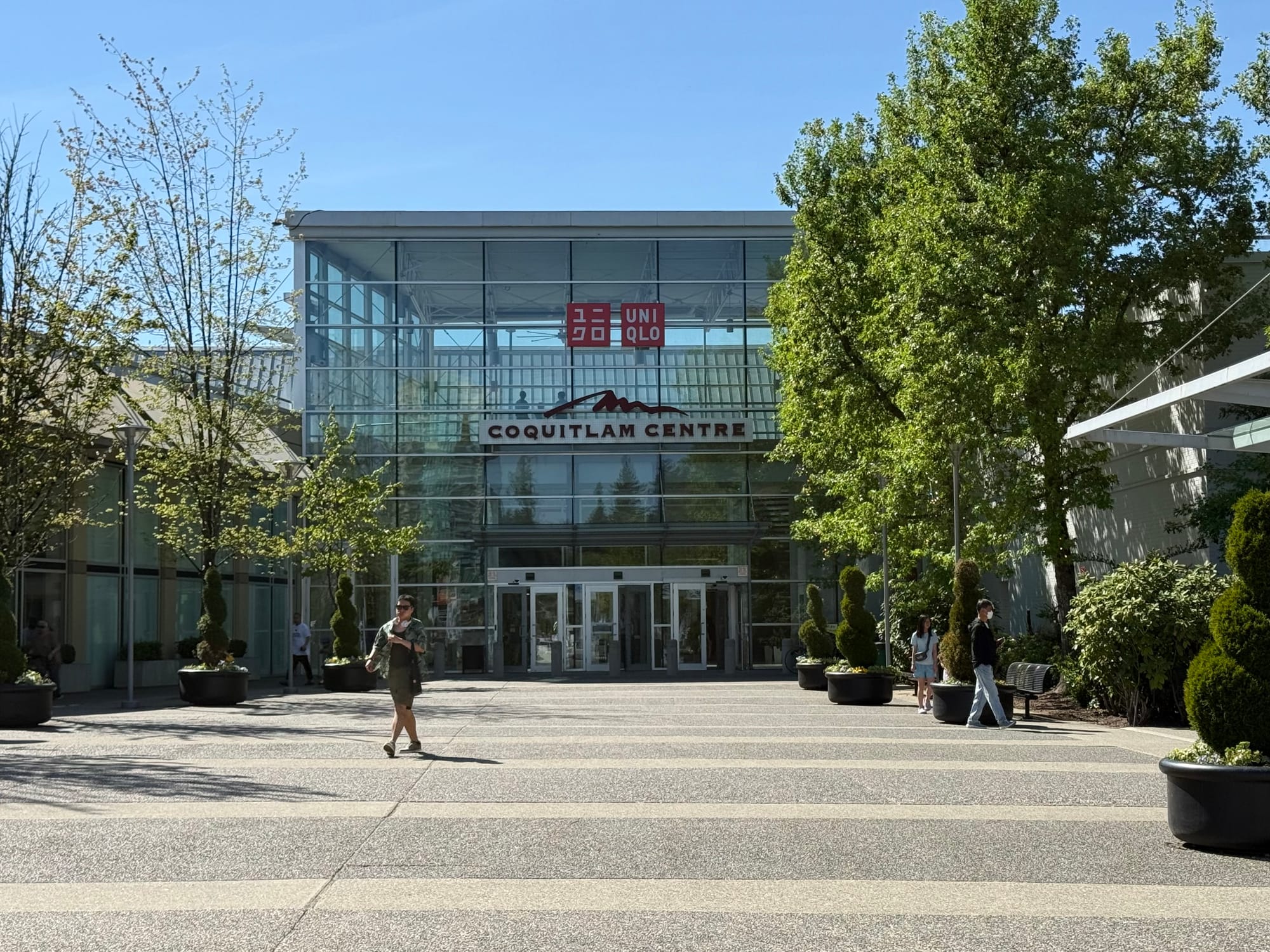
TOTAL SCORE
Small Stores: 7.1/10 (It’s a big mall with tons of popular brands throughout: Arc'Teryx, Bluenotes, Foot Locker and MINISO, to name a few. The mall itself doesn’t prioritize the smaller places, and for all the women’s apparel/jewelry places we’d like to see a little more variety and quirkiness, but overall there’s a sturdy base)
Anchor Tenants: 7.3/10 (It’s an interesting mall to classify in this way, because the largest stores are fairly meh: a London Drugs and SportChek, Accents&Home and Ardene, and the everpresent Walmart. But there’s also an Apple Store, Uniqlo and H&M — which are arguably bigger draws to younger demographics — in smaller spots. Let’s give the technical anchors a 6, the buzzier options a 9, and split the difference)
Food Court: 5.3/10 (While the mall has worked to have modern options in its retail settings, the food court is disappointingly retro: New York Fries, Manchu Wok, A&W and Orange Julius may be nostalgic, but you've also got a KFC and a Subway and very little in the way of fresh choices. You can’t give it a failing grade because there are lots of options and it’s fleshed out with some Vietnamese/Mexican options, but it’s definitely underwhelming)
Design/Accessibility: 5.7/10 (Ultimately, it’s a pretty good grid with wide aisles, but centred around those underwhelming or altogether closed tenant stores. The 21st century addition adds more stores, but has poor lighting and an atrium with minimal energy. Being next to two different SkyTrain stations but not actually integrated with either one is also frustrating. Certainly serviceable, but like the food court, a missed opportunity.)
X-Factor: 6.3/10 (The original wood and stained glass aesthetics are warm and inviting, and there’s ultimately a lot of different things you can do in Coquitlam Centre. But it also lives in an uncanny valley of a mall trying to make it 1997 again through science or magic. The dated design makes it feel less essential to the community, even though it technically occupies the same importance to Coquitlam as Aberdeen does to Richmond or Brentwood/Metrotown does for Burnaby)
OVERALL: 31.7/50 (This is a lot of words to describe a suburban mall that is still doing pretty well for 2026 without sparking joy. Good but not great, Coquitlam Centre isn’t making any bold choices or pivoting to the future, but for a big mall surrounded by parking stalls and centred around a Walmart and Ardene, you could do a lot worse)